
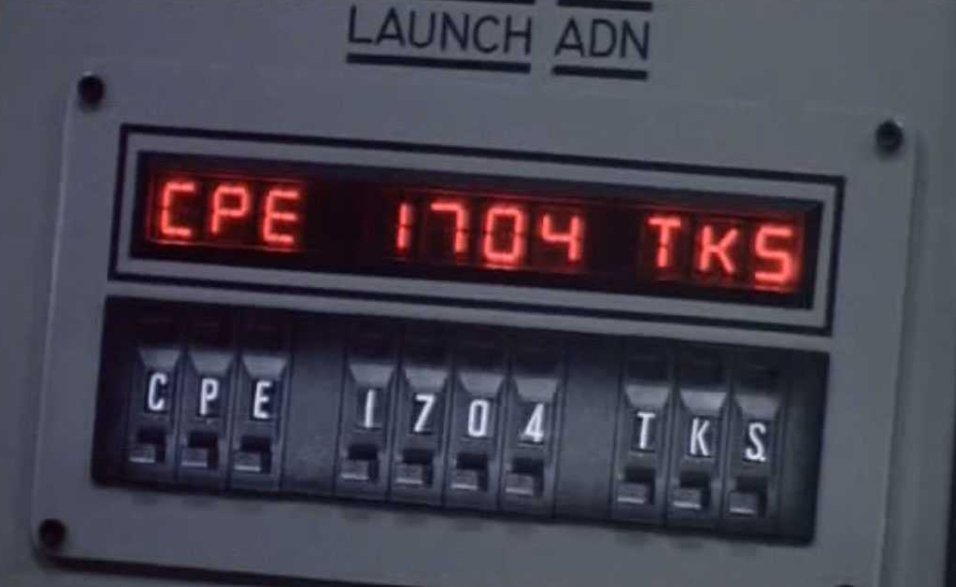
WarGames (MGM/UA 1983). The launch code Joshua works to crack as it runs the board to its end.
An old film, a man who would not turn his key, and the thing a machine had to compute its way back to.
I rewatch a lot of old movies. Not from one era. I move across them from the forties to the nineties. People assume a habit like that comes from missing a time you have decided was better. Not for me. I go back because I respect writing, and the older work tends to show the craft with the seams still visible. I look for something different while I watch each time. Why the writer chose that line and not another. How they slipped a reference past most of the room. What they trusted the audience to carry without being told.
I usually have one going in the background while I’m washing dishes or doing something mundane like downloading statements for reconciliation. Having grown up in the age of radio, it’s not a far stretch to ‘listen’ to the Wire while I’m watering my garden.
A few nights ago it was WarGames. Matthew Broderick, 1983. I had not sat with the opening in a long while, and the opening is the part that stayed with me.
It starts in a missile silo. Two officers. A verified security alert with a complicated verification system from 40 years ago and an order to launch. One of them turns toward his key. The other cannot do it. He will not turn the key that sends the missiles until someone confirms, with a voice he can answer back to, that this is real and not a drill and not a mistake. He freezes on the most important task he was ever given. From the standpoint of the system, that is a malfunction. The men upstairs watch it happen and draw the obvious conclusion. A certain percentage of human beings, when the moment comes, will not turn the key. So, take the humans out of the loop. Give the launch to the computer. The machine in the film is the WOPR, and it does not hesitate. That is the whole point of building it. The hesitation was the flaw they set out to engineer away.
Here is what the writers do with that, and it is the reason the movie is better than it had any need to be. By the end, the computer arrives at the exact place the officer’s hand stopped at the beginning. It runs every nuclear scenario it can generate, plays the whole board out to its conclusion again and again, and finds that every path leads to the same ruin. Then it says the line everyone remembers. The only winning move is not to play. The machine had to compute its way, at enormous speed, to the thing the man in the silo already knew in his body before the first calculation ran. The refusal they had labeled a failure turned out to be the wisdom we already had. They spent the movie building a machine to overrule the one human reflex that was working.
I take notes when I watch the way I once took notes when I sat listening to a sermon. The discipline never left me. And the note I kept writing was that this is an old idea wearing new hardware. Knowing when to stop is not a modern problem waiting on a modern fix. Nature settled it long before us. The wolf that loses the fight bares its throat, and the winner, almost always, lets it live. The predator breaks off the chase that costs more than the meal. The tree drops its leaves rather than try to hold the whole canopy through the freeze. Retreat got chosen, over and over, because the ones who never knew when to quit did not leave descendants. The wisdom writers said it plainly. There is a time to keep and a time to throw away, a time to be silent and a time to speak. The competence to act was never the hard part. The judgment to refrain is what gets honored, because it is rarer and it costs more.
I know something about sitting in a chair a system would have told me to leave.
For several years my wife and I cared for my parents in their sunset years when dementia and other physical ailments came to dominate their lives. On paper, that is the definition of diminishing return. Every quarter the inputs climb and the measurable output falls, and any optimizer worth its code would route the resources somewhere with a future. We built a small ADU for them on our property and kept watch anyway. We did not stay because the math told us to. We stayed because some decisions are not the kind you hand to a machine to total up, and a person who steps in front of that arithmetic and refuses to let it run is not glitching. He is doing the one job that does not scale and was never meant to.
It would be easy to read all of this as a man shaking his fist at the machine. That is not where I stand. A couple of years ago I wrote that artificial intelligence was going to be a real mercy for people living with dementia, and I still believe every word of it. A machine that never tires, never loses patience at the same question for the ninth time in an hour, never raises its voice, is a gift to a family worn down to the thread. The machine can carry an enormous amount of the load. What it cannot do is be the one who keeps watch. It cannot sit in the chair and decide, against the numbers, to stay. It helps. It does not replace. The distinction is the whole of it.
Which is why this film felt like it was about this week.
We are being told, constantly and from every direction, that a certain future is already decided. The phrase doing the work is some version of this is what you need, said as a fact rather than offered as a question. I watched the final season of HBO’s Hacks take that apart better than most of the serious commentary has managed. There is a stretch where a slick operator pitches the legendary comedian on letting the technology carry her voice and her appeal forward, and he leans the whole thing on inevitability, on the idea that everyone ends up here so she might as well be first. The young writer in the room, played by Hannah Einbinder, dismantles the inevitability piece by piece, naming the cost in power and water and human work that the pitch is built to skip past. She is the officer who will not turn the key on a confident voice she cannot answer back to.
The same scene is playing out in real towns right now, over data centers. Communities are standing up and saying no to buildings the industry presents as simply the way things are going. The residents are not confused or backward for it. They are looking at the actual draw. The hundreds of megawatts a single campus can pull off a regional grid. The millions of gallons of water going to cooling. Amazon reported using 2.5 billion gallons of water in its data centers last year. The tax abatements a city signs over before a single one of the promised jobs shows up, and the ratepayers who quietly absorb the transmission upgrade. None of that is hype. It is load, and it lands somewhere. When I wrote about data centers a couple of years back, the story was efficiency, how to build them so the cost did not strand on everyone downstream. The fights happening now are people declining to turn a key on the strength of a forecast they were told not to question.
That is the thread running from the silo to the dish water to the town council meeting. The danger in WarGames was never a machine that wanted to hurt anyone. The WOPR had no malice. What the story warns about is the room. People primed to move fast on a confident output, the missiles already pointed, and only one man left who understands the system well enough to walk in and say it is hallucinating, none of this is real, stand down. Professor Falken is the most valuable thing in the building. A scribe would call him the remnant. We should never let ourselves be talked out of keeping a human in the chair who is still permitted to refuse.
The code in the title is the nuclear one, the sequence that turns the key. But the deeper code the film is built on is the older one. The one that lets a person look at the board, see where every move leads, and decline to play. The machine in the movie spent its whole runtime learning that. The man in the silo had it from the first frame.
I keep going back to the old movies because the writers knew which of the two to trust, and they trusted the person.
So do I.