
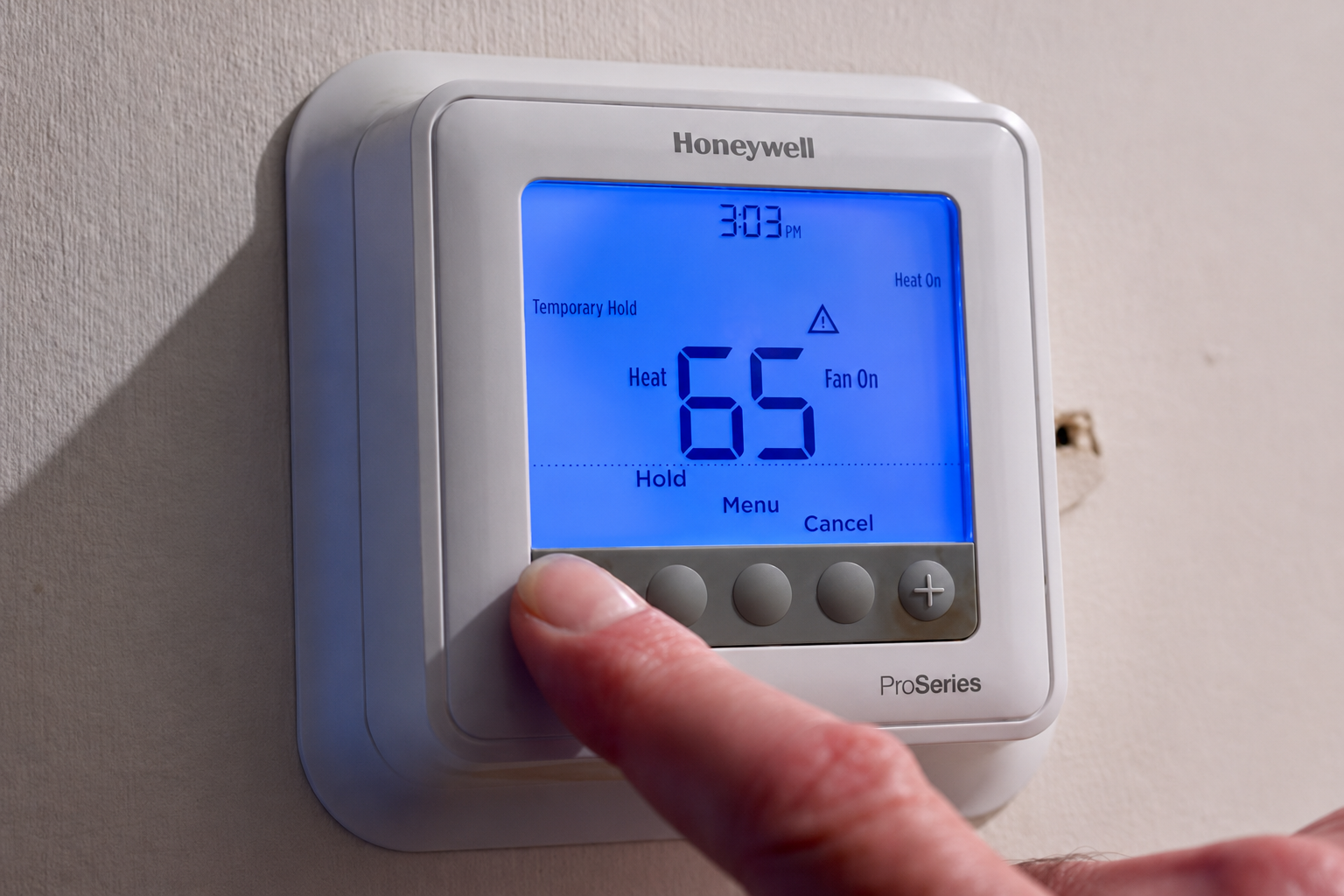
The photo showed a thermostat set to 65, the little screen glowing against the wall, and the caption underneath came close to “Come and take it.”
It was in the nineties outside. The grid was straining. A man in an air-conditioned room had decided the most useful thing he could do that afternoon was photograph his own defiance and put it where strangers could admire it.
The occasion was a request. New York was in the middle of a heat wave, the power grid was running near its limit, and the mayor had asked people to set their thermostats to 78 and turn off what they weren’t using, so the system would hold and nobody would lose power in the worst of it. Zohran Mamdani is a democratic socialist, which was apparently the only detail that registered. Dave Portnoy quote-posted the mayor with three words and an exclamation point, welcome to communism, and 4.3 million people saw it.
Set the label aside for a moment and look at what was actually asked. Seventy-eight degrees. Ease off during the hours of highest demand. This is not an exotic instruction. In Texas, the grid operator ERCOT has asked residents to set their thermostats to 78 during summer heat for years, the same number, for the same reason, phrased almost the same way. The figure is older than that. It traces to 1979, when Jimmy Carter directed that federal buildings be kept at 78 in summer and 55 in winter to ease the strain on the country’s energy supply. If a thermostat at 78 is communism, it is a communism that Texas runs every August and that a Georgia Democrat wrote into the federal government during the Carter administration.
The number was never the problem. When a Texas utility asks for the same thing, people do complain, but the complaint takes a different shape. A few summers ago, after one of ERCOT’s requests, there were stories about smart thermostats being nudged up remotely through programs people had opted into, and Tucker Carlson ran a segment on it. The word he reached for was creepy. Somebody reaching into your house without asking. The objection was about intrusion, about a faceless utility in your business. From Mamdani, the same request became an ideology. The ask had not changed, only the mouth it came from.
You can check this against behavior. The man who set his unit to 65 and posted the picture did not do that the last time a grid operator asked him to conserve. Nobody stages a protest against ERCOT by cranking the air and photographing it. The refusal is personal. It attaches to the mayor, and it would attach to no one else.
Once you see that, the thermostat stops being about electricity. It becomes the place to settle a different question, which is whether this particular man is allowed to hold the office he holds and ask anything of anyone at all. Mamdani is a socialist, so the word is pointed at something real. But the fight underneath it is older and simpler than any policy of his. Portnoy has already floated running against him. The response to a request about the power grid is to challenge whether the man should have standing to make requests. That was the subject from the start. The heat wave only gave it a thermostat to sit on.
There was another post going around that same week. It is the one a lot of reasonable people nodded along to. It made its case cleanly. These people don’t actually believe in freedom, it argued, they just want permission to do whatever they want at no cost to anyone but themselves, and it ended by calling them a name. Nearly every beat of it is probably right. But watch what the post is doing. It takes the same coordination problem, a grid, a heat wave, a few days of everyone giving a little, and turns it into a contest over who is the better sort of person. That is the same move. One side says the mayor is a communist. The other says the defiant are selfish. Both have quietly agreed that the real event is a referendum on character, and both have found their side of it.
Underneath all of it is something plainer than either side wants it to be. A heat wave arrived and asked a few million strangers to coordinate for a long weekend so the oldest and sickest among them would not die in the dark. For one way of seeing the world, being asked at all is the injury, because a request from a man you have decided has no authority over you is impossible to tell apart from a command, and the dial on the wall becomes the place to prove he holds no power over you. For the other, naming that becomes its own flag to wave. The heat and the grid are real. Every August, somewhere, the people who die in blackouts are counted. None of that is what the argument is about. Rather, it is about whether strangers are allowed to ask anything of each other, and it showed up wearing a costume with socialism written across the front.
The man in the photo is still in the cool room. Outside his window the load on the grid keeps climbing, and somewhere above him, on a top floor with the windows open, is the person the request was for.
References
ERCOT’s 78-degree conservation request and the 1979 Carter federal-building directive: WFAA, “ERCOT requests conservation, but why 78 degrees?”
Remote thermostat adjustment and the “creepy” framing: PolitiFact, “Tucker Carlson distorts Texas’ smart thermostat energy conservation programs,” July 2021.