
My father used to service fire extinguishers and drove a utility truck. The radio in it was almost always tuned to Dr. James Dobson. If he was taking me to school, Dobson was on. If I was riding along on a service call, Dobson or some other pastor was on. My father had dedicated his life after a few years of sobriety and would go on to become a Foursquare pastor and chaplain, a man who had read more theology than most people I have known since. Whatever Dobson said about how to raise a child or order a household arrived in our house already carrying the weight of scripture, because the man saying it had a doctorate and a national broadcast and a tone of complete certainty.
The teaching that stuck hardest was male headship. It was central to my father’s version of faith. My mother stayed Catholic most of her life, and while she converted to Pentecostal Christianity, she could see the gap between the doctrine and the daily reality of our home. He believed what he was taught, and he taught what he believed, and that is closer to the heart of the problem than anything I could say about him personally. The radio in the truck did its work on a good and serious man.
I thought about that truck this week when I read Gary Bauer’s piece for the James Dobson Family Institute, titled “Rededicate 250.” Bauer and his wife had gone to the National Mall on May 17 for an event he describes as a national jubilee of prayer and thanksgiving, declared by the current President. Bauer writes that Dobson, who died last August, watched it all from heaven, and that he probably would have been one of the speakers. He describes the day as the answer to decades of prayer, the moment our governing authorities finally rededicated the nation to the God of the Bible.
The word he uses for it is jubilee. He uses it twice.
It is the same word Senator Josh Hawley reached for last month at a Baptist seminary, and it is the same word the Bible defines with unusual precision. Because of my father, our house was full of dictionaries and commentaries, Greek and Hebrew and English and Spanish, and a word was never just a word. You looked up where it came from. That habit got into me early and never left, and it is most of what I do when something like this crosses my feed. So, I went and looked at the word.
The Jubilee is in Leviticus 25. It comes every fiftieth year. In that year, debts are canceled. Land that families lost returns to them. People who sold themselves into servitude to survive go free. The mechanism exists for a reason the text states plainly: so that wealth cannot concentrate permanently in a few hands, and so that no family is locked out of the means of life across generations. The Jubilee is the most economically radical institution in the Hebrew Bible. It is a mandatory, recurring redistribution of capital and land.
Bauer’s footnote tells you what the May 17 date actually commemorates. It points to a proclamation from the Continental Congress in 1776 for a day of humiliation, fasting, and prayer. That is the historical event he is honoring. A fast day. A day of national humiliation, in the old sense of the word, meaning a people bowing low to confess they had gone wrong.
So the event inverts its own source material twice over.
It calls itself a jubilee while honoring a fast of humiliation, which is nearly the opposite of a jubilee. And it claims the language of Leviticus 25 while the policies being celebrated move in the precise opposite direction from what Leviticus 25 commands. There is no debt cancellation in this jubilee. There is no land returning to families who lost it. There is no release for people who have sold their labor cheap to survive. There is a crowd on the Mall in ninety-degree heat, praising God for a government, while that government withdraws the kind of provision the actual Jubilee was written to guarantee.
This is what I have come to think of as the fast-food jubilee. The sign says jubilee. What you are served has none of the substance, calories, or nutrition the word promised, and was assembled fast, for a crowd, by people counting the crowd.
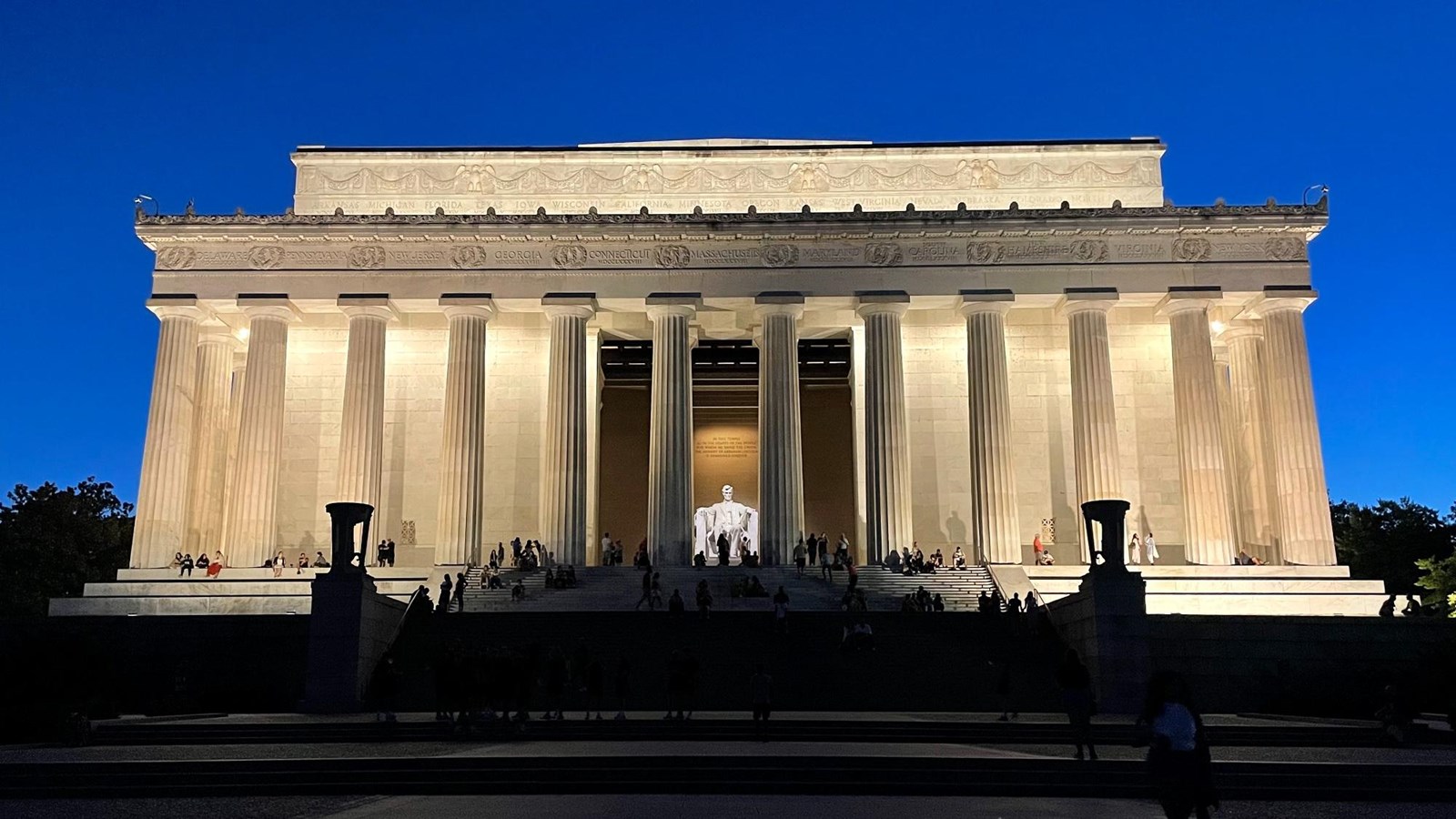
Bauer spends much of the piece on the architecture of the Mall, and here too, the detail undoes the argument. He points to the Capitol dome and notes that it shows George Washington ascending to heaven, offering this as evidence of the nation’s Christian foundation. The fresco is real. It is called The Apotheosis of Washington.
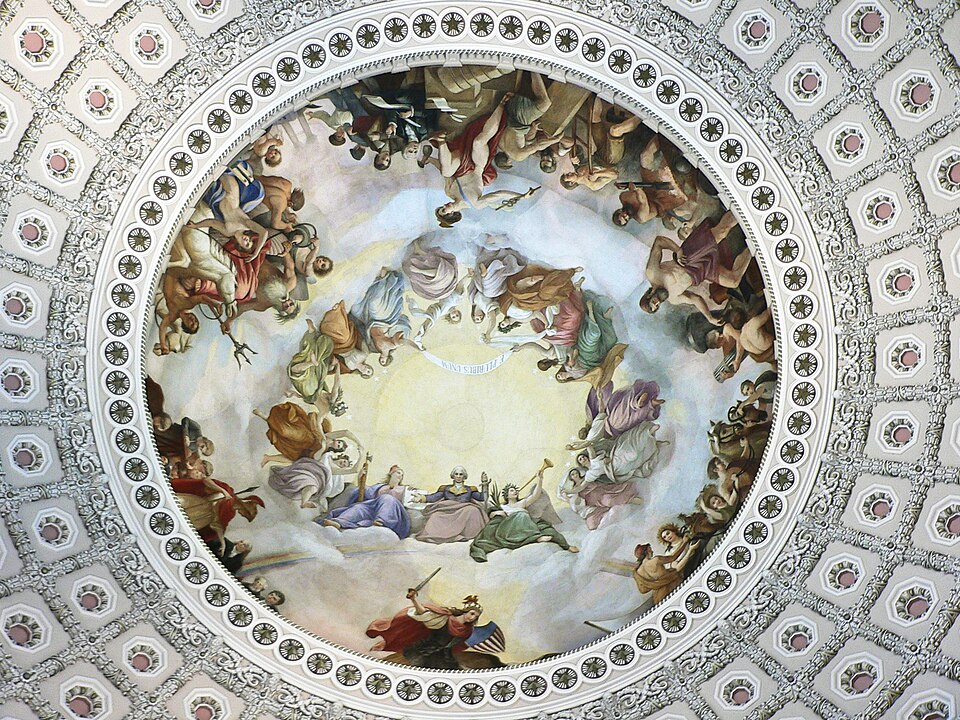
Apotheosis is the elevation of a man to the status of a god, a concept that comes from Roman imperial religion, not from Christianity. In the painting Washington sits among Liberty, Victory/Fame, Science and Marine. But there are also Roman deities. Minerva is there. Neptune is there. If you are arguing that the Capitol enshrines biblical faith, the apotheosis of a founder among pagan gods is the last image you want to raise, because the first commandment is the one about having no other gods, and the second is the one about graven images.
I do not point this out to score a debater’s point. I point it out because it is the same move, again. A word or an image that means one thing gets lifted out of its meaning and waved as a banner for the opposite. Jubilee for austerity. A Roman apotheosis for Christian heritage. A fast of humiliation rebranded as a celebration of arrival.
There were kids I grew up with, at my Catholic grade school and in the churches I attended, who were gay and knew it and could not say it. This was decades before they could say it and stay safe inside those walls. The teaching that came through my father’s truck radio, and through the institutions Dobson built, told those kids that who they were was a defect to be corrected or hidden. They learned to hide. Some of them carried that a very long way. I think about them when I read a sentence like Bauer’s about millions of American children being deprived of their inheritance. There were children inside his own movement who were deprived of the ability to exist honestly in the only community they had. That was an inheritance too.
I left the church in my twenties. My relationship with God withered and did not come back for a long time. What brought it back was not a rally and not a broadcast. It was my wife, whom I had first brought to church when we were teenagers, and who had found her own faith in the Pentecostal tradition. By the time we came back to it together I was old enough to question, to study, to keep what held up and set down what did not. Caring for my parents through dementia took even more of the inherited scaffolding away, and what was left underneath was steadier than what I started with. That kind of rebuilding takes years. It costs something. It cannot be staged in an afternoon on a lawn.
That is the part that I keep returning to. A faith that has been discipled, in the actual sense of that word, looks like the slow and expensive work of becoming someone who feeds the hungry and welcomes the stranger and tells the truth about himself. The Bible is not vague on this. It is among the most repeated instructions in both testaments. What gets staged on the Mall, draped in the flag, prayed aloud for the cameras, while contempt for actual poor and foreign and gay and different people runs underneath it, is a performance of the symbols of a faith by people who appear to have forgotten what the symbols were for.
Gary Bauer was appointed by President Trump to the United States Commission on International Religious Freedom. He ran the Family Research Council and was a senior vice president at Focus on the Family. He is not a bystander describing a day out. He is an architect of the fusion, writing from inside the government he is praising, calling it a jubilee.
My father is gone, and I loved him. What he believed, he believed in good faith, because the people he trusted believed it, and they sold it to him with total confidence over a radio in a truck. The confidence was always the product. It still is.
It is just broadcasting now from a stage on the National Mall instead of a frequency you caught on the drive to school.