
AS OF MARCH 23, 2026
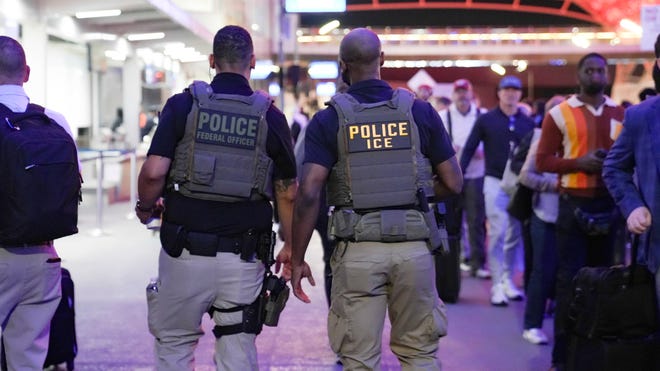
ICE agents are confirmed deployed today at 14 airports nationwide. The known list, per ABC News and multiple outlets, includes:
-
Chicago O’Hare International Airport
-
Cleveland Hopkins International Airport
-
Hartsfield-Jackson Atlanta International Airport
-
Houston George Bush Intercontinental Airport (IAH)
-
Houston William P. Hobby Airport
-
John F. Kennedy International Airport (New York)
-
LaGuardia Airport (New York)
-
Louis Armstrong New Orleans International Airport
-
Luis Muñoz Marín International Airport (San Juan, Puerto Rico)
-
Newark Liberty International Airport
-
Philadelphia International Airport
-
Phoenix Sky Harbor International Airport
-
Pittsburgh International Airport
-
Southwest Florida International Airport (Fort Myers)
TSA callout rates hit 11% on March 21, their highest since the shutdown began. At Houston Hobby, nearly half of TSA agents did not report to work. Wait times at some airports reached 220 minutes on Sunday. Travelers are advised to arrive at least 3 hours before departure. Peak congestion periods: 4–7 a.m. and 3–6 p.m.
Starting today, ICE agents are deployed at U.S. airports. The stated purpose, per border czar Tom Homan on CNN’s State of the Union Sunday morning, is crowd control and exit door security to free up TSA for screening. That may be accurate as far as it goes. But the legal authority ICE agents carry into those spaces extends well beyond crowd management, and the landscape governing that authority shifted significantly in 2025. Travelers should understand what that means before they arrive at a checkpoint.
The Context
DHS has been partially shut down since February 14. The trigger was Congressional demands for ICE and CBP reform following the fatal shootings of U.S. citizens Keith Porter, Alex Pretti, and Renee Good by federal agents. Since then, over 400 TSA officers have resigned, nearly half with more than three years of experience. Callout rates hit 10.22% on Friday alone.
ICE, meanwhile, has not faced a funding crisis. The agency received $75 billion from last year’s budget legislation. TSA is short-staffed and unfunded. ICE is not. That gap is the backdrop for everything that follows.
The Fourth Amendment Baseline
TSA operates under an administrative search exception. When you enter a checkpoint, you consent to security screening. That consent is specific and limited. It does not transfer to ICE. ICE authority derives from the Immigration and Nationality Act, 8 U.S.C. § 1357, and requires its own legal basis for any stop, search, or detention.
What Noem v. Vasquez Perdomo Changed
In 2025, the Supreme Court stayed a lower court injunction that had blocked ICE from stopping people based on suspected ethnicity, language, workplace, and location. The stay arrived through the shadow docket: no full briefing, no oral argument, no majority opinion. Justice Kavanaugh wrote a solo concurrence. Three justices, Sotomayor, Kagan, and Jackson, dissented.
Kavanaugh’s concurrence holds that apparent ethnicity can be a relevant factor in establishing reasonable suspicion for a brief investigative stop, provided it is combined with other factors rather than used alone. Courts had previously been more consistent in blocking stops grounded in appearance. That standard is now lower. The case remains in active litigation in the Central District of California, with plaintiffs having filed a Second Amended Complaint in February 2026 adding Equal Protection claims under the Fifth Amendment. The law here is live and unsettled.
What This Means in Practice
A brief investigative stop under Terry v. Ohio requires only reasonable suspicion. Under the current legal posture, ICE agents may combine apparent ethnicity with other observable factors — accent, language, attire, location in the terminal — to meet that threshold. An arrest still requires probable cause or specific statutory authority under 8 U.S.C. § 1357(a)(2), which limits warrantless arrest to situations where an agent has reason to believe the person committed a felony and is likely to escape before a warrant can be obtained. Understanding the difference between a stop and an arrest matters.
Judicial Warrants vs. Administrative Warrants
If ICE presents a warrant, ask whether it was signed by a federal judge. A judicial warrant compels compliance. An I-205 Warrant of Removal is an administrative document. No judge reviews or signs it. A May 2025 DHS memo instructs agents it can be used to make arrests. Whether that is constitutional has not been fully resolved by courts. You have the right to ask which type of warrant you are being shown.
Your Rights by Status
U.S. Citizens. State it clearly. Carry a passport or passport card. It is not legally required, but carry it anyway. In Minneapolis, documented U.S. citizens were detained, zip-tied, and removed from their homes after agents disputed their citizenship on the spot. Theory and practice are not aligned right now. State your citizenship. Text someone immediately. Document everything.
Lawful Permanent Residents. You are required under 8 U.S.C. § 1304(e) to carry your green card. Present it if asked. You have the right to remain silent beyond confirming your status and the right to an attorney before answering substantive questions. Do not consent to searches of your phone or belongings beyond your immigration documents. Comply with TSA screening as you normally would.
Visa Holders. Present your visa documents if asked. You are not required to answer questions about your personal life, employment, associations, or political views. The Fifth Amendment right against self-incrimination applies to every person physically present in the United States, regardless of immigration status.
Undocumented Individuals. Constitutional protections apply to you. The Fourth Amendment protects against unreasonable search and seizure. The Fifth Amendment gives you the right to remain silent. You have the right to refuse consent to a search. Do not run. Do not provide false documents. Do not sign anything without speaking to an attorney first.
Search your bags or body using TSA consent alone. That consent does not transfer.
Seize your phone without a judicial warrant.
Detain you indefinitely without charge.
Coerce a statement. Anything obtained through coercion is suppressible in subsequent proceedings.
If ICE Approaches You
Stay calm. Do not physically resist. Ask: “Am I free to go?” If yes, leave. If no, say: “I do not consent to this encounter. I am invoking my right to remain silent. I want to speak with an attorney.” Then stop talking. Do not explain. Do not clarify. Do not fill the silence.
Document Everything
ICE agents must identify themselves and provide their agency if asked. Note badge numbers, time, location, and the exact words used. Text a trusted contact immediately. If you witness an encounter, you have the right to observe and record from a safe, non-interfering distance. That right is recognized in most federal circuits under ACLU v. Alvarez, 679 F.3d 583 (7th Cir. 2012), and the Supreme Court declined to review it. Your documentation may become evidence in a constitutional challenge.
Resources to Save Before You Travel
- Know Your Rights: ACLU.org/know-your-rights
- Immigration attorney locator: ImmigrationAdvocates.org
- Emergency immigration legal help: NationalTIMNetwork.org
- Recording rights by state: RCFP.org
The Larger Picture
The Noem decision came through the Supreme Court’s emergency shadow docket with no full briefing, no oral argument, and no majority opinion. Two lower courts had already ruled against the government before the Court intervened. The case is still being actively litigated. The Fourth Amendment exists. The Fifth Amendment exists. The Fourteenth Amendment exists. The legal ground is contested, not abandoned.
50,000 TSA workers have gone without pay for more than 37 days. ICE has $75 billion. ICE is at airports today because the agency responsible for keeping planes safe has been defunded while the agency that killed U.S. citizens and faced no accountability has not. Those are the facts. They belong in the same sentence.
This post is civic legal education, not legal advice. For your specific situation, consult a licensed immigration attorney. Original thread by Maja Porter, Esq. (@majaporter on Threads). Airport list sourced from ABC News reporting, March 23, 2026.