
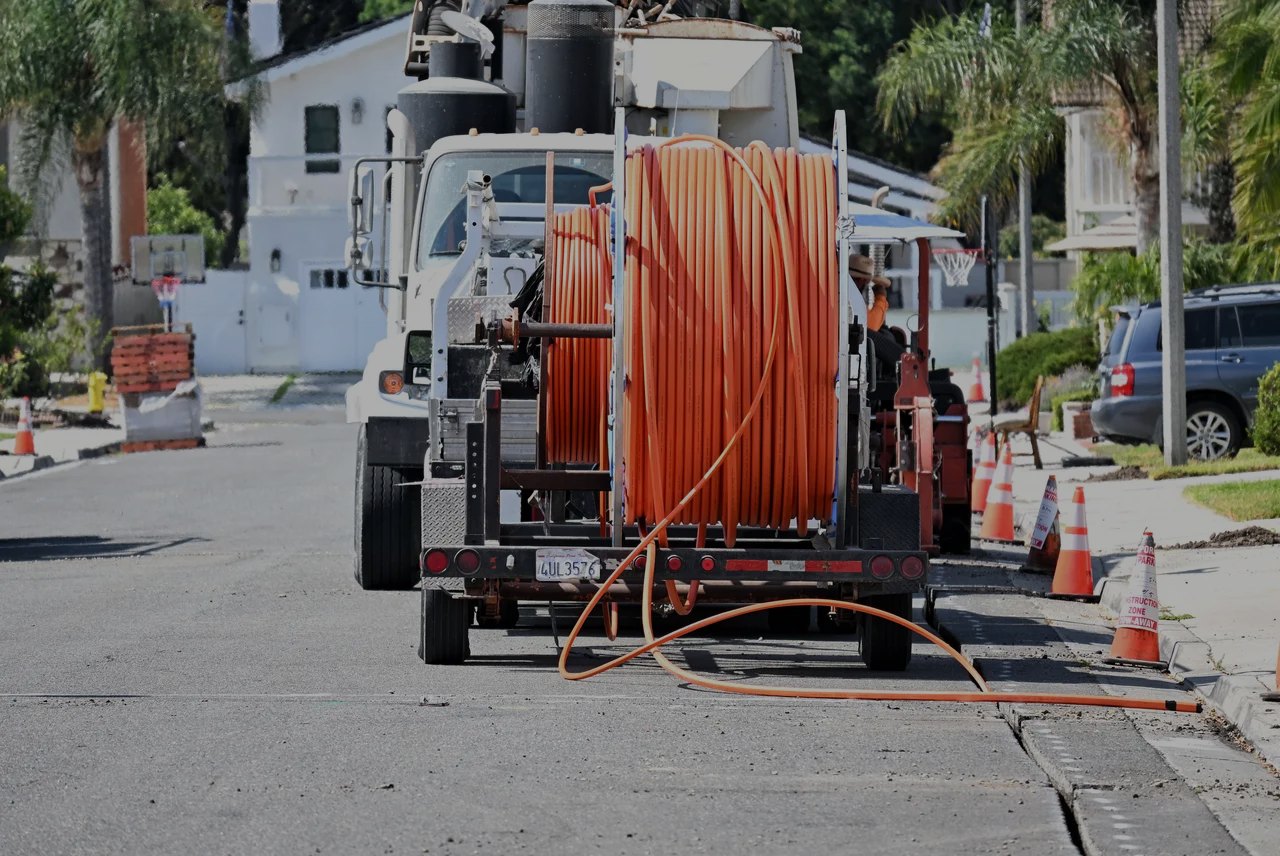
In the early 2000s I ran a low-voltage systems company with my brother out of a 2,200-square-foot shop wedged between two auto dismantling yards. We wired buildings. Access control, cameras, communications, and the thing everyone in the trade had suddenly started talking about, fiber. I sent my brother to get trained on it so we could bid the cable work ourselves instead of subbing it out. He came back able to terminate and splice glass thinner than a hair. We believed what the whole industry believed then, that internet traffic was doubling every hundred days and that whoever could carry the data would own the next twenty years.
WorldCom was still in business. It was one of the companies selling that number to the country, and the country bought it. WorldCom, Global Crossing, Qwest, and a dozen others were tearing up the ground and laying fiber across the continent and under the oceans, far more than anyone was using, on faith that the demand would arrive to fill it. My brother and I were a small part of that faith, running strands into computer rooms and telecom closets around Los Angeles, sure we were early to something enormous.
The demand did not arrive on schedule. Most of the fiber those companies laid sat dark, unlit glass in the ground earning nothing. The number was closer to a wish than a fact, and some of the accounting underneath it turned out to be a crime. WorldCom collapsed in 2002 in an eleven-billion-dollar fraud, the largest bankruptcy the country had seen to that point, and its chief executive went to prison. My own company did not survive that stretch either, for reasons that had more to do with my brother and me than with anything in the ground.
Then something quieter happened, over years, while most people stopped paying attention. The dark fiber stayed where it was. It got bought out of bankruptcy for pennies on the dollar. When a website called YouTube wanted to send video to everyone at once, and Netflix wanted to mail you a movie without the mailing, the road was already built and already paid for by somebody else’s collapse. The companies that laid it were gone. The glass was still good. Some of this sentence is reaching you through it.
I think about those strands lately, because we are standing inside another build just like it, and this time the pipe is the data center.
The five largest tech companies are on track to spend more than a trillion dollars on AI infrastructure this year. They are borrowing to do it at a scale that is hard to hold in your head: roughly a hundred and sixty billion dollars in new bonds in the first five months of the year, more than those same companies borrowed in the previous five years combined. A large share of the revenue that supposedly justifies the spending is the companies buying computing power from one another and booking each other’s payments as demand. The Bank for International Settlements, not an institution given to drama, placed the bursting of this bubble near the top of its list of risks to the global financial system, alongside railway mania and the dot-com crash. Jeff Bezos, building his own share of it, called it an industrial bubble. Sam Altman has said plainly that some investors are going to lose a lot of money.
Whether it is a bubble is settled. The question that holds me is the one Cory Doctorow puts at the center of his new book, The Reverse Centaur’s Guide to Life After AI: when it deflates, what stays in the ground, and is any of it worth having.
Not every collapse leaves the same thing behind. The telecom bust left the internet. Fifteen years later the fraud was a footnote and the fiber was infrastructure. A more recent mania left almost nothing. Around 2021 the country spent a fortune on cartoon apes, images that changed hands for the price of a house because a line on a blockchain said you held the original. When that market stopped there was no fiber in the ground, no road, nothing to inherit, just a picture of an ape and a lighter bank account. Crypto more broadly landed in between, a few durable rails and a great deal of fraud and vapor around them.
This build will leave both kinds, and the useful part is worth naming precisely. The buildings are real. The substations, the power lines, the fiber feeding them, the cooling plants, the water hookups, the transmission upgrades utilities had to pull forward to serve the load, all of it is durable infrastructure that will outlast whatever the valuations do. That is the dark fiber of this cycle. But a data center is more than its building, and the difference matters. The most expensive thing inside it is a wall of chips, and a chip ages in a way glass does not. Fiber my brother spliced in 2001 still carries traffic. A high-end AI processor bought this year is most of the way to obsolete before the loan that paid for it is retired. Part of this wreckage will be infrastructure a region is glad to have, part of it will be very expensive scrap, and the buildings will sit in somebody’s county either way, useful or stranded, with the power bill and the water draw already charged to the town.
Doctorow’s title names the thing the hype is built on. A centaur, in the older tech usage, is a person made more capable by a machine, the tool working for the human. A reverse centaur is that arrangement turned around, a person harnessed to the machine and made to keep its pace: the driver routed to deliver without a break, the warehouse worker timed against a screen, the programmer handed an impossible volume of machine-written code to check. The machine sets the tempo and the human is the part that has to keep up. The projected value of this technology, some sixteen trillion dollars, only pencils out if it replaces an enormous quantity of paid human labor, which is why every story about AI, including the one where it takes all our jobs, is written first for the investor deciding whether to wire in another hundred billion. Underneath the noise sits Doctorow’s flat little observation: nobody has built a machine that can do your job.
I watched the reverse-centaur economy up close this spring, when my son graduated and started looking for work. He wants to run stadium and event operations, and he did what the system tells a graduate to do. He applied. A friend of mine who runs a hiring platform told me about one opening at a company people actually want to work for: sixteen hundred applications in the first day. Half were disqualified on the basics. The remaining eight hundred were qualified and indistinguishable, the same credential-shaped resumes, the same cover letter a model wrote in under a minute, and a hiring manager with no way to tell them apart. Both sides of that exchange were handed the same machine. The applicant tunes the resume to the language in the job description. The employer’s software tunes its ranking to the language in the resume. A model writes the letter and another model scores it. Everyone optimizes, the optimizations cancel, and eight hundred real people flatten into noise no one can read.
The job still gets filled. It gets filled the way it has been filled for a century, by someone trusted saying a name in a room the candidate is not in. The flood of identical applications did not weaken that path. It made it the only one with any signal left in it. When sixteen hundred resumes say the same nothing, the one person willing to vouch for you is the whole market.
That is the part of this build worth keeping, and it is the part no one is capitalizing. When the bubble lets go, and it will, some of what remains will be dark fiber, the power and the pipe and the buildings that keep working after the story ends, and some of it will be cartoon apes, and it will take years to sort which was which. The strands my brother learned to splice are still down there, carrying traffic, indifferent to the companies that went broke laying them. My son works the schedule the restaurant gives him, and in the mornings before his shift, he makes his calls.