
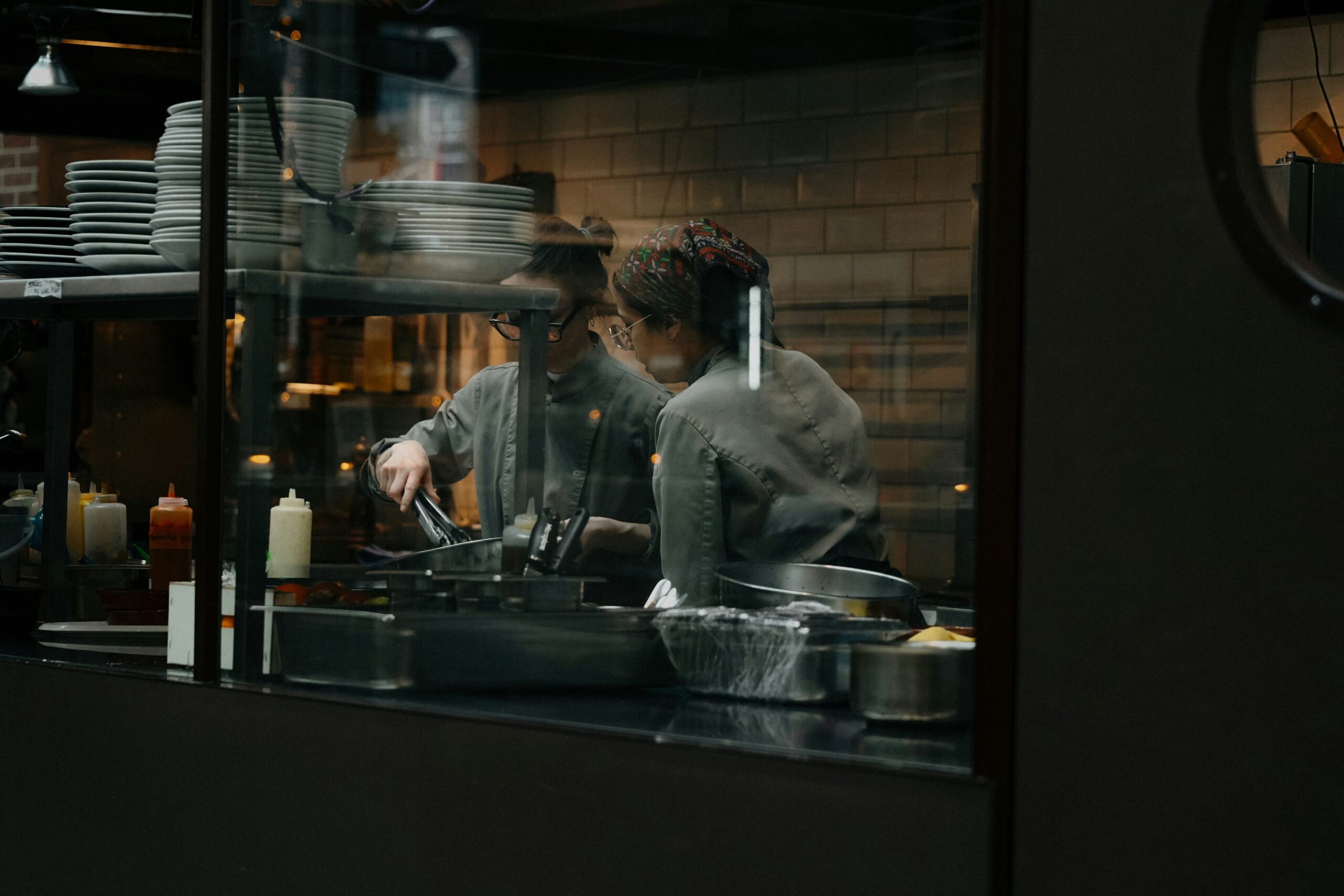
Stephen Starr went broke in the comedy business before he ever plated a dish. He was running a club then: a leased location that was a deli by day and his stand-up club at night. Once his partner tried to cut him out of the business, he found another location that was REO (real estate owned) by a bank and got a deal of a lifetime where he was able to buy it for practically no money down. Somewhere in the middle he could no longer make the payments as the business was losing money. He stopped paying the note and the bank took the building, sold it to someone else, and as far as he can tell, nobody ever came after him for the shortfall. Starr has said since that he should have sold the place himself and kept whatever was left. He didn’t, because at the time he had no idea what he was doing.
The part before signature successes like Buddakan and Pastis and Le Diplomate, before Starr Restaurant Group cleared close to half a billion dollars a year, the failure Starr notes is a setup. The young man who did not know what he was doing becomes the wise old man. The loan he walked away from is one of the stones he stepped on to get across to his life of success in food and beverage.
What did his entrepreneurial story need in order to work? The walk-away to have been survivable. No personal guarantee chasing him from one state to the next, no credit file that made the next landlord hesitate and the next lender flinch. He got to fail and then get out from under it and, in the plainest sense, move on without the failure following him into every room after. This is not some story from the 1950s. This is 30 years ago in the 90s before YouTube and the stranglehold of algorithms businesses must bow to each day to stay relevant and clear of any bad signals.
Survivable failure was one part of it. The other part was a person, singular. The money that let Starr keep opening rooms came from a single investor who was comfortable with his risk, and he did not turn that investor up through a form or a portal. A venture fund manager who knew him went looking and found the one person willing to live with the profile, made the introduction, and that investor has backed his deals ever since. Someone with discretion looked at a risk a screen would decline and carried it, by hand, to a person who might say yes.
When Starr talks about all this now, he’s a bear on bootstrap entrepreneurship. What he did back then, he says, is not doable today. The days of building something out of nothing, with a friend and some nerve and a landlord willing to wait, are behind us. You need a balance sheet behind you now. He puts the change in scale and money, in how much it takes to open the door. Sitting under that, unnamed, is the slow retreat of forgiveness from the system that decides who gets a turn.
The loan officer who once read a person across a desk has become a score. The community banker who could look at a borrower going under and structure a workout, stretch the terms, buy the operator two more quarters because he believed him, has become a servicer following a decision tree with no field for belief. Character is one of the five “C’s” of credit a human being gets to weigh. It has been pushed out of the room, and the thing sitting in its chair is a spreadsheet that assesses your financial track record through a personal and business creditor report showing whether you are reliable enough through the debts you have repaid in the past. It is a number, not a person.
The independent restaurant Starr built by hand is now the kind of asset that gets assembled rather than grown. The HVAC company, the accounting firm, the commercial cleaning outfit, the veterinary practice, each one now sits somewhere on a private equity timeline, a platform forming or a platform already formed, bought and folded on a clock that has nothing to do with the owner and everything to do with where the cycle is. The patient local capital that used to wait for a person to figure it out has been replaced by capital that already knows what it wants and exactly how long it will wait. When Starr says you need a balance sheet behind you, that is the room he is describing.
The asymmetry shows up in the smallest line items. When Starr signs a lease now, the landlord pays to build the space out, because his name on the deal makes the buildout worth funding. A first restaurant with a thin balance sheet covers that itself, the plumbing and the hood and the walk-in, out of pocket or on a bank loan or an SBA product or a slice of equity handed to whoever will front the cash. The established operator is handed a finished space. The newcomer pays to build it before anyone has eaten there.
The part of his story that made him is the part that cannot happen the same way again. He got to be a beginner who failed and vanished. Default now, walk away from a guarantee, and the event is logged the day it happens, sold to a bureau, scored, and surfaced at your next application by a system that never met you and has no interest in the rest of your life. The building gets taken either way. What went missing is the mercy that used to come after.
“You can’t do it anymore” is the easiest sentence an aging founder can say and the most useful one a stalled one can hear. It excuses the meeting you talked yourself out of, and it turns a decision you made into a condition that was done to you. I know the pull of it because I have leaned on it. In my twenties I ran a systems integration company and spent a couple of years pitching a roll-up to private equity firms in New York, and I was told, in every phrasing you can think of, that I was too small, too wide, too unfocused. Some of those meetings I never made, because I lost the nerve to walk into the building. Some of it really was the closed door in front of a young brown kid with no balance sheet. Some of it was that I did not walk in. The story that blames the machinery lets you keep those two things mixed together, so you never have to sit down and separate them.
Scroll far enough and the machine introduces itself. A founder who builds AI for real estate posits that loan underwriting is dead. He has not read a collateral package by hand in weeks. His software takes a deal apart in twenty minutes, runs the valuation and the debt coverage and the loan-to-value and the comps, and prints a lender-ready report. Two days of work, he says, now takes forty-two seconds. He has heard every objection, that the data isn’t reliable, that collateral needs human judgment, that a model can’t weigh credit risk, and his answer is that the argument is over, the good lenders already switched, comment AI on the post and he’ll send you a login.
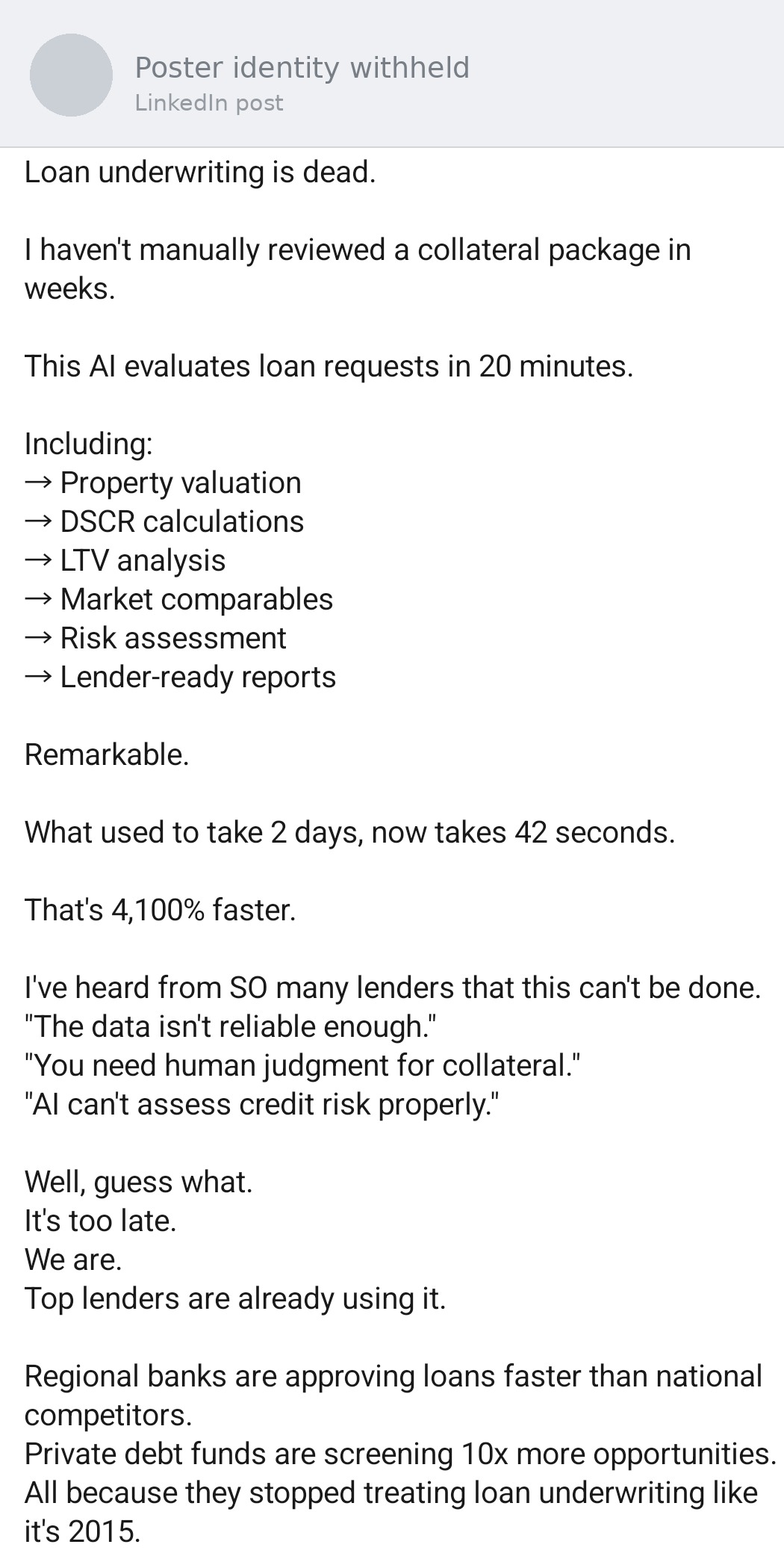
A post announcing that loan underwriting is dead. Identity withheld.
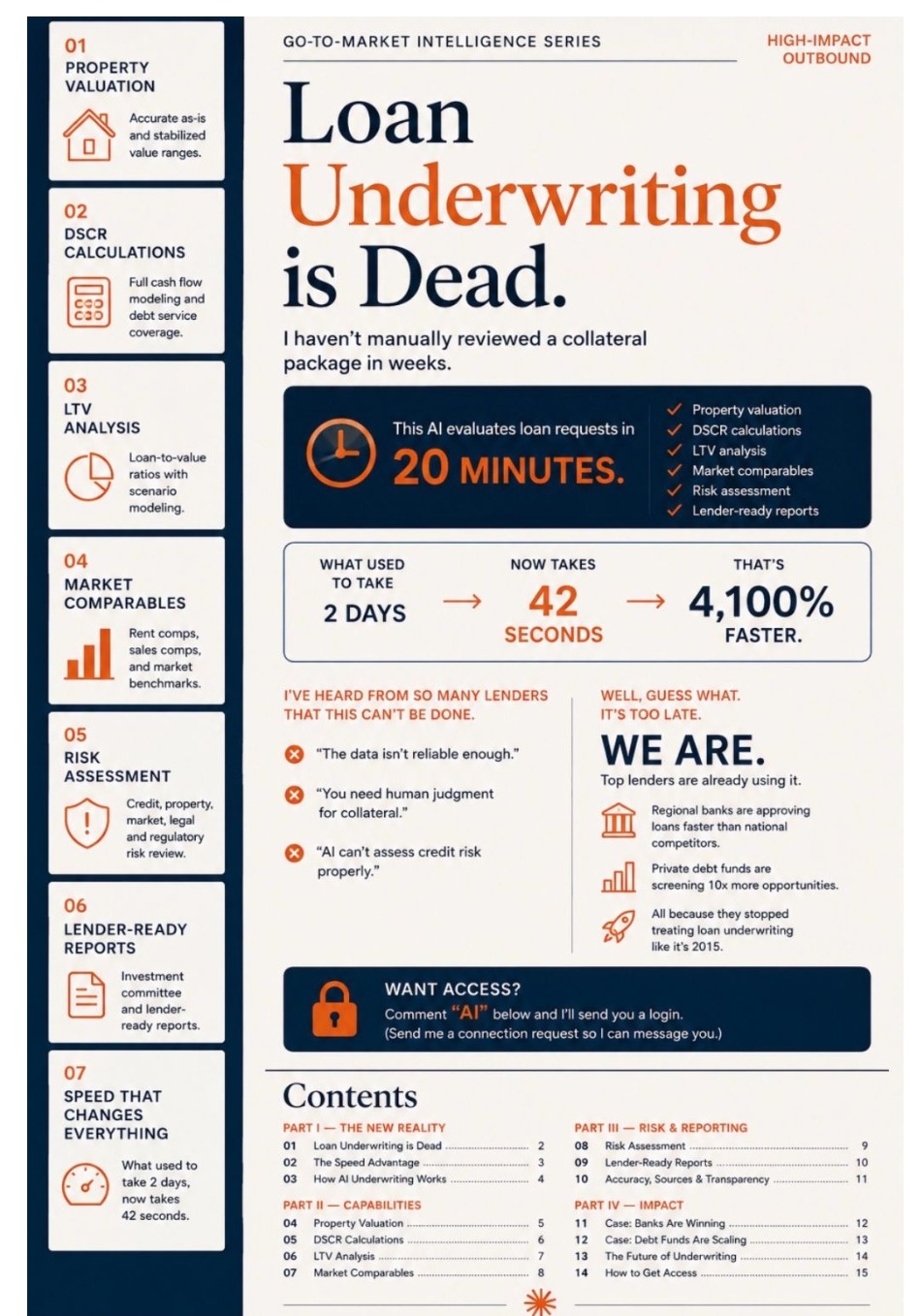
The same pitch, dressed as a market one-sheet.
The collateral review is the hinge. Reading a package by hand was slow because a person was doing it, and the person was the point. That was the seat where somebody could look at a borrower the numbers wanted to reject and decide the numbers were not the whole story. The forty-two-second version is faster and cleaner and it hands back an answer no one in the room can argue with. It also cannot look up from the file and reconsider you.
The banker who could forgive a defaulted loan was also the banker who decided, in a handshake, who reminded him of himself and who did not. Starr reminded enough of the right people of enough of the right things, and the doors opened the way they open. The kid I was learned the reading went the other way as often as not. The machine in that seat now would have turned Starr down and turned me down in the same forty-two seconds, in the same words, and that is the first time the two of us would have been read exactly alike.
Hero photo by Mathias Reding on Unsplash.