
There’s a difference. Most of the headlines around single-family rentals miss that distinction. They focus on whether the market is “cooling” or “slowing,” as if that answers anything useful for an investor or operator.
It doesn’t.
What the industry is seeing is a market that has reset its pricing, stabilized its fundamentals, and is now forcing discipline back into decision-making. That’s a very different environment than what most people got used to from 2020 through early 2022.
Pricing Has Reset. Cash Flow Hasn’t.
Cap rates have moved meaningfully. From a low in the mid-5% range in 2021 to roughly 7.3% today. That’s not a minor adjustment. That’s a full repricing of the asset class. At the same time, rents have continued to grow, just at a slower pace. National rent growth is sitting around 2.6% year-over-year, which is closer to historical norms than the post-pandemic spike.
Home values, meanwhile, have flattened. Roughly 0.3% annual growth . Put those three together and you get something important:
-
Cash flow is doing more of the work again.
-
For a long stretch, appreciation covered mistakes. Today, it doesn’t.
Demand Isn’t the Question Anymore
The demand story is not speculative but structural at this point. The data shows households would need to spend about 42% of income to purchase a home which is a big constraint that tends to persist longer than people expect.
Occupancy reflects that. Sitting around 94%, right in line with long-term averages.
The more telling signal is that single-family renter households have reached a seven-year high. That doesn’t happen in a weak market.
Capital Is Available. Just Not Easy.
This is where most borrowers get tripped up. The capital markets haven’t shut down. They’ve recalibrated. CMBS issuance is still active, around $6.4B in 2025 and tracking consistently into 2026. REITs are buying again, with net acquisitions turning positive and reaching $600M in Q3 2025. But the terms have changed: Debt yields have climbed to 11.3%.
That single number explains most of what borrowers are experiencing. Lenders are requiring more income relative to loan size. Which means:
-
Lower leverage
-
More equity
-
Stronger in-place cash flow
-
Less tolerance for “future upside” stories
You can still get deals done. You just can’t get them done on narrative alone.
The Spread Matters More Than the Cap Rate
A 7.3% cap rate doesn’t tell you much by itself. The spread does. SFR is now trading at roughly a 317-basis-point spread over the 10-year Treasury. That’s a real risk premium again. It also sits about 160 basis points above multifamily and is a gap is worth paying attention to.
It suggests that:
-
Institutional capital still sees SFR as less efficient than multifamily, but
-
Is more attractive than it was when pricing was compressed
There’s room for capital to continue flowing into the sector, but it will be selective.
Build-to-Rent Isn’t a Trend. It’s a Shift.
Build-to-rent has pulled back from peak levels, but it’s still elevated.
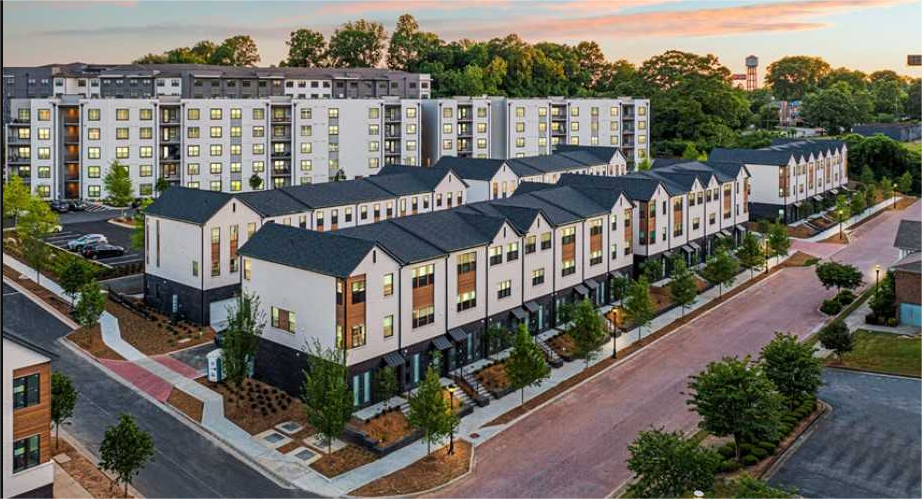
About 69,000 units started over the past year, representing 7.2% of all single-family construction. That percentage matters more than the absolute number. Because it shows how the development model itself is changing. This is no longer just scattered-site investing. It’s becoming a product type. And once a product type becomes institutionalized, it doesn’t revert.
What This Means for You
Most of the conversations I’m having right now come down to the same issue. People are trying to apply yesterday’s assumptions to today’s structure. That’s why deals break.
A few things that are worth adjusting:
1. Leverage is earned, not assumed
If the deal doesn’t support it on in-place or near-term cash flow, it’s not a leverage story.
2. Appreciation is not your backstop – Underwrite to stability, not upside.
3. Capital partners are thinking in spreads, not narratives – If the risk-adjusted return doesn’t clear their threshold, the story won’t move it.
4. Execution matters more than timing – This isn’t a market where waiting solves problems. Structure does.
The Quiet Shift – There’s a tendency to label this kind of market as “boring.” It isn’t. It’s just less forgiving. The volatility has been replaced with constraint which forces clarity. That usually ends up being a better environment for people who know what they’re doing.
Download the one-page briefing: Key SFR metrics and four things worth adjusting in your deal structure.