
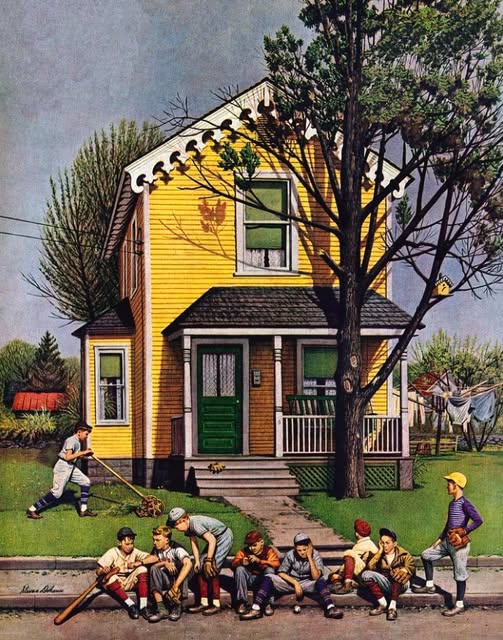
I came across a painting recently: Baseball Player Mowing Lawn by Steven Dohanos, 1946.
At first glance, it’s a simple image that could be mistaken for a Norman Rockwell: a young ball player dutifully mowing the lawn while a group of his teammates waits, gloves and bats in hand. But the more I looked at it, the more it stirred deep inside me because it looked like my childhood in certain ways.
I grew up with the rare privilege of a front yard and a backyard. And with it came responsibility.
Most kids looked forward to sleeping in on weekends, but not our house. Rather than sitting in front of the TV watching cartoons, I would hear my mom’s voice calling me from the hallway at 6 or 7 a.m. By the time I rubbed the sleep out of my eyes and made it outside, she had already been up, swept most of the driveway, and made tidy piles of leaves for me to finish the job, with about ten instructions on what she wanted done while she watered the plants before it got too hot.
Responding and getting up wasn’t optional. It was understood. It was love, shaped into work ethic.
At the time, I was a boy who wanted to get straight to playing baseball or riding my awesome blue and gold Torker BMX bike. In the early years, I was only allowed to go a few houses in each direction and warned to watch for cars backing-out of driveways. But as I got older, that bike became my ticket to the world. I graduated to riding to baseball practice up the incline of Scholl Canyon, a few miles and a few hundred feet of elevation away, later swapping my BMX for a Univega 18-speed and a Campagnolo cycling cap that flipped up in the front. I was free.
But only after I earned it.
With the work assigned, I groaned. I negotiated. I probably cursed under my breath a few times. But the groaning would become humming and usually let me wander deep in thought about whatever a young kid thinks about. Today we might call it “flow state.”
But I always did it. It didn’t take long to understand why. There was a certain pride in how clean and healthy things looked once everything was done, especially when I had to trim the bushes and I had made perfect edges. I’d coil the hose perfectly in a flat spiral as the final task knowing I was done.
I played Little League and Babe Ruth baseball throughout my youth. Most Saturdays were game days. Sacred. But before I could put on that jersey, before I could run bases or stand at the plate, I had to take care of my home. That was the deal. The field came after the yard. My mom was teaching me that before you go out into the world, you tend to your own space. You care for what you’ve been given.
What I didn’t realize then was that she was laying the foundation for a work ethic that would show up in every aspect of my adult life: in business, in service, in marriage, in fatherhood.
And as a father myself, I passed on a version of this same ritual to my own children. Maybe not at 6:30 a.m. sharp. I softened the edges a bit. I also liked to enjoy the quiet of an early morning for myself, but I understood that while the principle is timeless, the method could evolve. The lesson wasn’t about perfection or punishment. It was about presence, discipline, contribution. I found ways to make it ours.
Where my mom used early mornings and leaf piles, I might use music in the background, shared chores on a group app, or simply start the day with a little prayer and group text message to talk about what needed to be done.
The heartbeat was the same: your effort matters. Your hands matter. And before you go out into the world to ask for something, you give something back to the space you call home. Even though two of the three kids are barely starting out as independent adults in college, they’re learning quickly how rough and tumble the world can be and how these tools come into play.
In my book, You’re Our Only Hope, I write about the hidden teachers in our lives. The people and practices that shape us when we’re not paying attention. Yard work on a Saturday morning might not seem profound. But it taught me to show up, pay attention, and lead by doing. I am a firm believer it is what has opened so many doors, including how I received a scholarship to go to college, married the love of my life and was given the gift of adopting her kids.
Sometimes the most ordinary rituals become the bedrock of our legacy.
And if you’re reading this while in charge of young lives, as a parent, auntie, or nana, wondering whether those early-morning reminders or household expectations are making a difference…they are.
Maybe not today. But one day, that kid will see an old painting, or hear a familiar rake scraping the concrete sidewalk, and feel the rhythm of what you taught them echo in their own lives.